

Every gambler has the same epiphany eventually.
Usually, it happens after a couple of drinks, staring at a roulette table. A lightbulb goes on.
“Wait a minute,” you think. “If I bet on Red and lose, why don’t I just double my bet on the next spin? If I lose again, I’ll double it again. Eventually, Red has to hit. And when it does, I’ll win back all my losses, plus a profit.”
Congratulations. You have just rediscovered the Martingale strategy. It is the oldest, most seductive, and most dangerous betting system in existence.
It is dangerous because for the first twenty minutes, it looks like it works perfectly. It feels like you’ve found an infinite money glitch.
But Martingale is not a strategy to beat the casino. It is a mathematically guaranteed way to turn a small, fun gambling session into a catastrophic financial loss. Here is why the logic fails in the real world.
The Seductive Logic
On paper, Martingale seems flawless. You are betting on a near 50/50 outcome (like Red/Black).
Let’s say your base bet is $10.
- You bet $10 on Red. It lands Black. (Loss: -$10)
- You double your bet to $20 on Red. It lands Black. (Loss: -$30 total)
- You double to $40 on Red. It lands Black. (Loss: -$70 total)
- You double to $80 on Red. It hits Red.
You win $80. You paid back your previous $70 in losses, and you have $10 left over. You made a profit equal to your original bet.
It seems foolproof because, surely, the ball can’t land on Black forever?
The “Gambler’s Fallacy”
The first crack in the armor is your own brain.
Humans are terrible at understanding independent events. We suffer from the “Gambler’s Fallacy”—the belief that if something happens frequently now, it’s less likely to happen in the future.1
If you see five Blacks in a row, your brain screams that Red is “due.”
The roulette wheel has no memory. It doesn’t know what happened on the last spin. The odds of hitting Red are exactly the same after ten Blacks in a row as they are on the first spin. Long losing streaks happen constantly. If you play long enough, you will eventually see 8, 9, or 10 Reds in a row.
And that is when the Martingale system demands you put your entire bankroll on the table just to win back your original $10.
The Real Killer: The Table Limit
Let’s assume you are rich. You have an infinite bankroll and nerves of steel. You can weather any losing streak. You should win, right?
Wrong.
Casinos thought of this centuries ago. The ultimate defense against the Martingale isn’t bad luck; it’s the Table Limit.
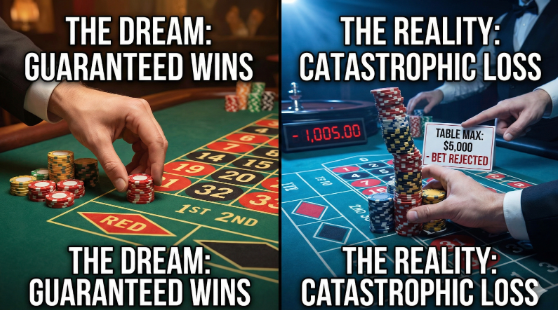
Look at that little plaque on the table. It might say “Min Bet: $10, Max Bet: $5,000.”
Let’s see how fast you hit that wall starting with a $10 bet:
$10 -> $20 -> $40 -> $80 -> $160 -> $320 -> $640 -> $1,280 -> $2,560.
If you lose that $2,560 bet (which is your 9th loss in a row), your next required bet is $5,120.2
You cannot make the bet. The casino won’t take it. You have hit the table limit. You are now down over $5,000, and the system has completely failed. You cannot double down to recover.
The Verdict
There are countless betting systems out there. You can read about dozens of them on here: www.rouletteuk.co.uk/strategies, ranging from complex number tracking to simple progressions.
But most of them, especially Martingale, suffer from the same fatal flaw: they require you to risk a massive amount of money to win a tiny amount of money.
Martingale works nine times out of ten. You’ll grind out small $10 wins and feel like a genius. But that tenth time, when the inevitable streak hits and you slam into the table limit, it wipes out weeks of previous winnings in thirty seconds. It works until it doesn’t, and when it stops working, it hurts.
