

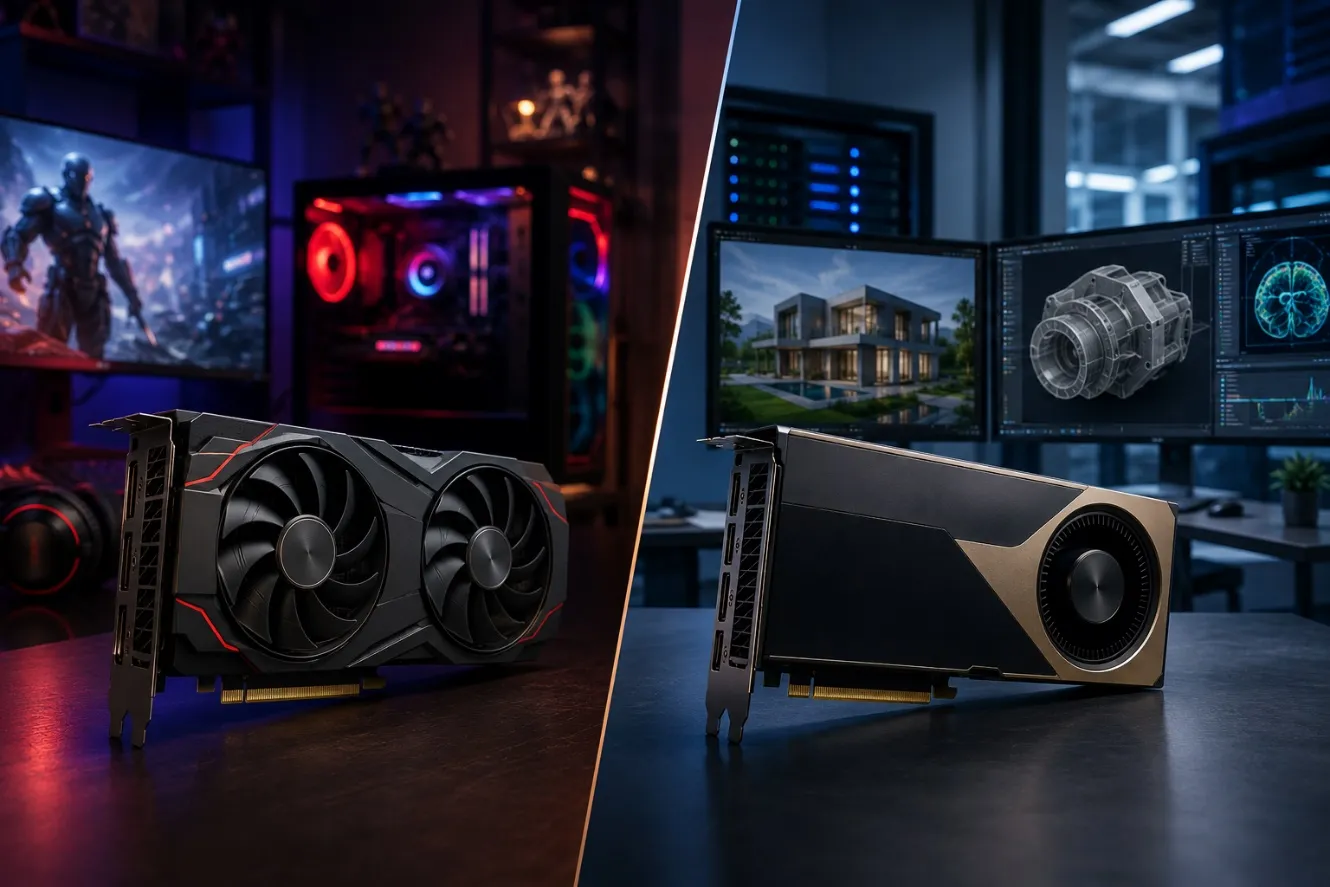
While you can use GPUs to play games or run casual applications, the capabilities of these devices far transcend entertainment. They now play integral roles in scientific simulation, engineering, artificial intelligence (AI), video editing, and 3D rendering workflows. However, the professional hardware is fundamentally different from the consumer hardware, and it’s designed for the unique workloads that professionals use at the workstation.
For companies evaluating workstation hardware or cloud GPU solutions, understanding the differences between consumer and professional GPUs is essential. The rtx 6000 pro based solutions are attracting the attention of the engineering teams, AI developers, as well as creative studios looking for performance on a whole another level of scale.
This article explores the major distinctions between consumer GPUs and professional GPUs and explains why many organisations are choosing platforms like CloudPe to access professional GPU resources.
Purpose and Intended Workloads
The biggest difference lies in the target audience.
Consumer GPUs have the purpose of gaming, creating content, or the tasks requiring intensive graphics performance. The priority of consumer GPUs is entertainment, high refresh rates, and value to a single user.
Professional GPUs, on the other hand, are designed for industries such as architecture, manufacturing, media production, healthcare, engineering, scientific research, and artificial intelligence. Those situations call for stability, in the long haul; proven software and performance predictable, instead of performance that comes with gaming benchmarking.
The rtx 6000 pro family is specifically aimed at professionals working with advanced rendering engines, CAD software, digital twins, simulation platforms, and AI-driven applications.
Memory Capacity and Data Integrity
One of the most noticeable differences between consumer and professional GPUs is memory.
Professional GPUs almost always feature drastically increased memory capacity to accommodate immense datasets and complex work. The NVIDIA RTX Pro 6000 Blackwell features up to 96 GB GDDR7 ECC memory which users will use for extremely large AI models, complex 3D scenes and heavy engineering simulations beyond what would be achievable with most gaming graphics cards.
For professionals creating feature films, visual effects, or large-scale digital environments, this additional memory can dramatically improve productivity.
Reliability Over Peak Gaming Performance
Gaming GPUs are often tuned to maximise frame rates in entertainment applications. Professional GPUs focus instead on stability under sustained workloads.
Animation work done for a number of days in a design firm – or AI models trained for days in a lab – would really be a problem if they could crash or misbehave. Such hardware has been certified to work without failure for prolonged periods, and is typically coupled with certified drivers for business use.
This emphasis on reliability makes professional GPUs attractive for organisations where downtime directly affects deadlines and revenue.
Software Certification and Optimisation
Professional GPUs are frequently certified for leading enterprise software packages used across industries. To work with professional application such as for example in Computer Aided Design (CAD) applications, in combination with CAD-MEP and Engineering Simulation and Analysis or digital content creation, and in Medical Imaging.
Consumer GPUs generally prioritise gaming driver updates and entertainment features. While they may run many professional applications successfully, they are not always tested or certified to the same level for mission-critical business environments.
Studios using tools such as Autodesk Maya, Blender, Cinema 4D, Siemens NX, or other demanding software often prefer workstation-class GPUs because of their enhanced compatibility and long-term stability.
AI and Machine Learning Capabilities
Artificial Intelligence has quickly become a foundational component in a myriad of present-day workflows, image generation, large language models, simulation, robotics, and data science, just a few examples that utilize GPU acceleration as the foundation.
The rtx 6000 pro incorporates advanced Tensor Cores and Blackwell architecture enhancements designed to accelerate AI inference, generative AI, and machine learning workloads while also supporting graphics-intensive applications. NVIDIA highlights fifth-generation Tensor Cores and fourth-generation RT Cores alongside its 96 GB ECC memory configuration.
Although even consumer-grade GPU can handle AI production, the professional GPU series come with additional larger memory size and enterprise-level functions for advanced production setups.
Precision Rendering and Visualisation
Architectural firms, industrial designers, animation studios, and visual effects teams require highly accurate rendering capabilities.
They were made to withstand the strain, offer reliable ray tracing capabilities, and provide you with cutting edge visualisation pipelines within high-accuracy professional and engineering applications. Real-world light simulation and precise engineering schematics can only be accomplished on professional GPUs.
This makes the rtx 6000 pro an excellent choice for professionals producing high-end visual content or validating engineering designs before manufacturing.
Scalability for Enterprise Workloads
Businesses often need infrastructure that can scale alongside project requirements.
This Professional GPU range is primarily installed into workstations, render farms, or used in the cloud by those who use the latest collaborative applications across geographically disparate teams. These workstations are designed to let companies scale their data sets and the number of concurrent users while pushing their rendering applications further.
CloudPe enables companies to leverage professional GPU resources without purchasing expensive workstation hardware outright. Instead of investing heavily in physical infrastructure, organisations can scale GPU usage based on active projects and operational requirements.
Total Cost of Ownership
Although consumer GPUs generally have a lower purchase price, the initial hardware cost tells only part of the story.
Additional factors to take into account when business shopping for computing units embrace maintenance and upgrades, system downtime and support, electrical use and power cooling, and the overall expandability of a system going forward. Professional graphics units might prove cheaper in the long run as a result of their diminished interruptions to the workflow and their expanded ability to handle the needs of a small or particular enterprise operation.
Accessing the rtx 6000 pro through CloudPe further improves cost efficiency by allowing organisations to pay for GPU resources when they need them, rather than making large upfront capital investments.
Who Should Choose a Consumer GPU?
A consumer GPU may be the right option if your primary activities include:
- PC gaming and streaming.
- Casual video editing.
- Basic 3D modelling projects.
- Personal creative work.
- General-purpose desktop computing.
When it comes to individual artists, gamers or any person on a tight budget these are great graphics cards that offers a great deal.
Who Benefits Most from a Professional GPU?
Professional GPUs are better suited for:
- 3D rendering studios.
- AI and machine learning teams.
- Engineering and CAD professionals.
- Scientific computing environments.
- Architecture and construction visualisation.
- Virtual production and visual effects.
- Enterprise software development.
- Large-scale simulation workloads.
ECC, qualified drivers, accelerated AI, more VRAM in such cases can have an important positive impact.
Why Businesses Are Turning to CloudPe
Purchasing high-end workstation hardware can be expensive and difficult to scale as project demands change. CloudPe is an ideal provider for businesses that require elastic access to high-powered GPU hardware and the ability for teams to spin up, manage, and decommission them as they need without worrying about the upkeep of hardware.
Whether rendering demanding scenarios, training AIs, or performing engineering simulations, companies can benefit from the professionalism and GPU performance while remain flexible and within costs for hardware expenses.
“Using advanced hardware like the rtx 6000 pro coupled with cloud availability enables businesses to quickly innovate without significant investment in new capital.”
Final Thoughts
The choice between a consumer GPU and a professional GPU ultimately depends on workload requirements. Consumer graphics cards remain excellent for gaming and everyday creative tasks, but businesses running mission-critical applications often require the stability, memory capacity, certified software support, and sustained performance that professional hardware provides.
For organisations seeking enterprise-grade graphics and compute capabilities, the rtx 6000 Pro represents a compelling solution. CloudPe, combined with its adaptable cloud system, will equip organisations to meet the needs of computationally intense tasks such as rendering, AI, simulations, and visualization, without having to purchase or install the expense of managing high-spec systems in their own premises.
